
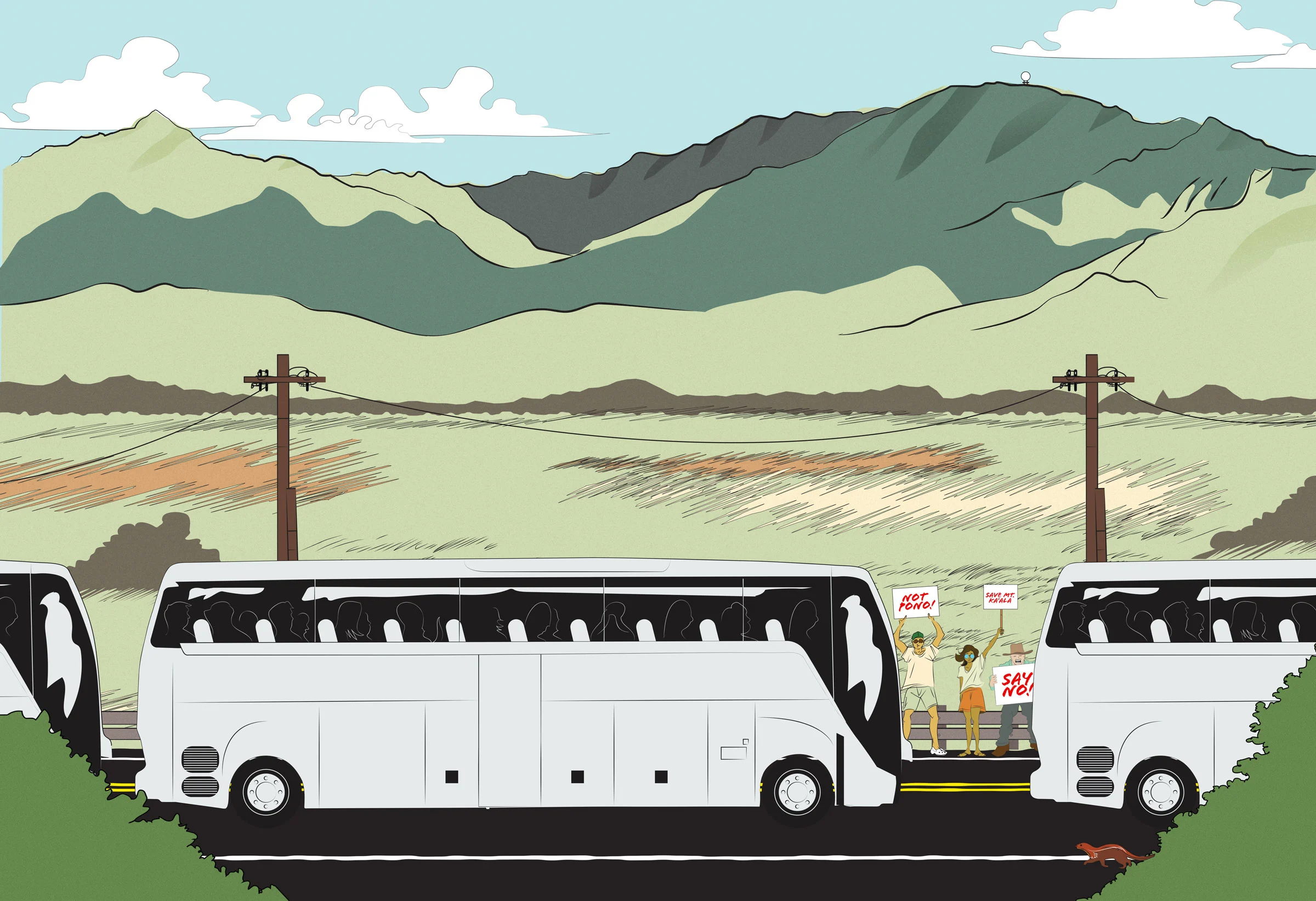
Kilohana chief administrator Tyler Gomes says regenerative or sustainable tourism must start with community input. “Right now, a lot of the revenue that’s generated through tourism doesn’t stay in the state,” he says. “In order for tourism to be accepted, the community will have to feel that it is getting benefits beyond congestion, beyond development, beyond a simple drain on its resources.”
He noted that when opposition to a project is as strong as in the case of Mount Ka’ala, “that’s a sign that the community is probably hurting and doesn’t feel like people are listening. Advocates have to ask themselves: Does this community really need a gondola? A little introspection is a good thing.”
Milner agrees. He says “not in my backyard” is a knee-jerk reaction, and misunderstandings and a vocal minority have killed projects that could have benefited the community in a big way. But he says that’s not what’s happening with the gondola project. He says it has been pitched as an “accessory use” to new agricultural production and broad conservation efforts, and that it “looks like too much fancy frosting on a cake that’s not very tasty.”
“It looks like you’re putting something up there to make money,” he says.
State Rep. Amy Perruso, whose district includes Waialua and Mokulē’ia, is among those the developer has accompanied to the Kaukonahua Ranch site to hear the proposal. “It was so clear to me: That’s not a place humans should be,” he says. “It’s an incredibly sacred and beautiful place.” But, he says, the project looks good: it has brought communities together, united by outrage.
“Keeping the country country is not just about loyalty to a slogan, but this area is fragile,” says Perruso. “It’s hard for the community to fight so many battles on so many fronts. This is a great opportunity to have a deeper conversation.”
North Shore farmer and neighborhood board member Racquel Hill-Achiu is among those leading the charge against the gondola project. At the community meeting in July, he warned attendees that they were in for a long fight.
“What we’re trying to do is show both DPP and the developer that we’re not here just to hang around,” he says. “This mountain is the highest peak on this island and that alone is of great importance to all of us, no matter where you live.”
For Antolini, the gondola battle is a big one, but not the only one. He says the issue of over-tourism, especially on the North Shore, is one that will require much more community involvement and public investment. “Regenerative tourism I think that when a visitor comes, they actually give back through an activity,” he says. “To make real regenerative tourism, our community needs support.”
