

Photo: Gregg Hoshida
Aanthropologically speaking, my food awakenings have always been milestones by which I measure my life.
It’s the summer of 1975, and I’m with my mother visiting her friend in McCully. Out comes a large porcelain plate with a pyramid of vienna sausages in shoyu sugar that glisten in the afternoon light. For a 6-year-old armed with a chopstick, it’s the height of culinary elegance.
Spring 1986: I’m in Japan for the first time, in Yamagata prefecture with my high school band. The bowl of hot, perfectly cooked rice that appears in front of me forever raises the bar for what Japanese rice should be.
Summer 1995: I’m in a random park in Paris, eating a peasant’s lunch of a freshly baked baguette and a dry sausage from my backpack. Dessert is a small bag of currants. For a brief moment, I am a bon vivant, living my best life.
Summer 2026: I walk into a new Punjabi Pakistani restaurant next to an empty lot on Sheridan Street. This time, a different bowl of rice elevates my perspective.

Photo: Gregg Hoshida
Biryani King opened behind Walmart in May with little fanfare and big flavors. The restaurant is owned by Shahnaz Hameed, who moved from Virginia to be near her son and new grandson to open her Punjabi cuisine restaurant. Hameed is of Indian origin, from the Punjab province of Pakistan, which borders the Indian state of Punjab. Both are landlocked regions and Punjabi food is all about meat. Unlike much of Indian cuisine, which reflects its Hindu roots, in Muslim Punjab, beef is among the options. There is no coconut in Hameed’s food, which uses different seasonings than most Indian restaurants in Honolulu.
SEE ALSO: Namaste brings Indian and Nepali cuisine to Waikīkī’s doorstep
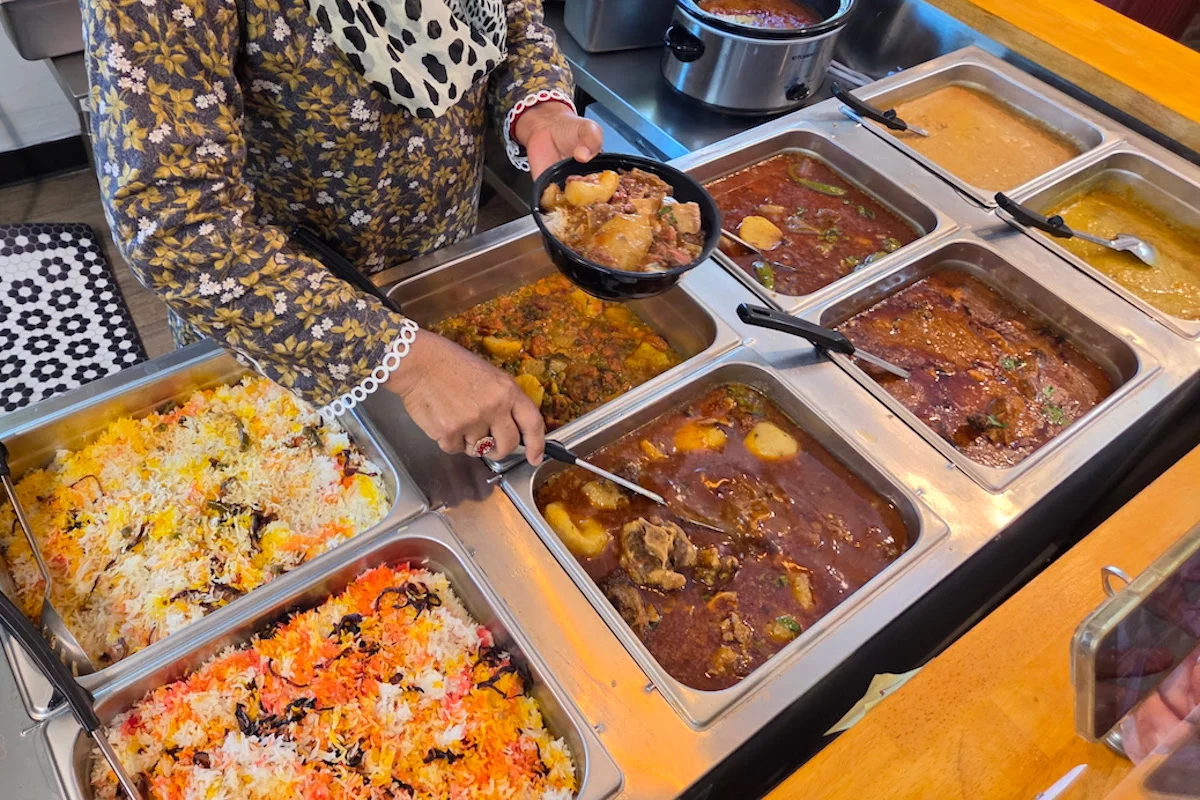
Inside Biryani King, aromas of warm spices and braised meats fill the small dining space. The walls are decorated with scenes from the spice markets and cuisines of Pakistani Punjab. The menu is simple and consists of tasty biryani rice dishes accompanied by simmered options such as braised oxtail, butter chicken, daal tadka and chana masala.

Photo: Mari Taketa
A meat glutton, I order a bowl of braised oxtail on a bed of perfectly cooked basmati rice ($19.99) and the vegetable biryani ($14.99 a la carte, $19.99 with two sides) with small portions of aloo mattar gajar and achar gosht (card or goat). Hameed arrives every morning at 4:30 to begin the day’s cooking, so the bites sing with flavor and the strong backbone of the meaty broths. The oxtail is rich in collagen, with a medium heat from the chiles and comforting spices that weave through the meat and drip into the rice; a cilantro and fresh mint chutney adds a bright accent. Soft, slow-cooked vegetable aloo mattar gajar is highlighted by carrots so sweet they taste like yams.

Photo: Mari Taketa
The two biryanis are a revelation and the stars of the show. The meat for the beef biryani is marinated in yogurt and homemade spices; it was chicken on one visit and goat on another. Impossibly fluffy, both the meat and vegetable biryanis rise with the heady perfume of cinnamon, cardamom, onion, ginger and other spices. They come with little cups of spicy lassi on top. These biryanis give energy to the main character. I could eat them every day.

Photo: Gregg Hoshida
Dishes are made from scratch, including tandoor charcoal-baked naan ($3.99), roti ($3.99) and several lassi ($4.99) made with this homemade yogurt. Hameed’s food makes you feel like you are eating at his kitchen table. It is warm, welcoming and comforting.

Photo: Gregg Hoshida
Parking is available in a small lot next to the restaurant. Although the stops appear to be randomly painted, just park in the same way as an adjacent car and do not block the exit. And don’t bring cash – Biryani King only takes cards.
Every day except Monday from 10 a.m. to 2 p.m. and from 4 p.m. to 8 p.m., 704 Sheridan St., Ala Moana, @biryanikingoahu
Greg Hoshida is a longtime regular contributor to Frolic Hawai’i. @oldmanfood
