
“PBS Hawai’i had a goal from the beginning,” says Mary Bitterman, station manager from 1974 to 1979. “Our commitment, in a sense, was not to have programming for some people all the time, but to have programming for everyone.”

Recording session at the Hawai’i Educational Television Studio, 1969. Photo: Courtesy of PBS Hawai’i
To that end, the station, then called the Hawai’i Educational Television Network, or HETV, produced programs that highlighted Native Hawaiian culture, local food, music, and sports. There were live forums with panelists discussing local issues and a show dedicated to the elderly was called Pau Hana Years.

Keith Hathaway operates a camera in the HETV studio, 1969. Photo: Courtesy of PBS Hawai’i
Current programs include songs, Home is here i ok on PBS Hawaii and ‘Ono! Hawai’i food culture on YouTube.
This month marks 60 years of telling Hawai’i’s stories and the start of a year-long commemoration of that milestone. HETV broadcast its first programs from the University of Hawai’i on the Mānoa Lab School campus on April 15, 1966.

Host Nino Martin, left, HETV Executive Director and General Manager Mary Bitterman, center, and HETV anchor Charles Stubblefield stand next to a remote production truck. Photo: Courtesy of PBS Hawaii
In 1970, the station joined the Public Broadcasting Service, PBS. To this day, thousands of children watch and learn Sesame Street and other educational programs on TV and online while adults tune in to favorites like NEW, nature, FIRST LINE and classic masterpieces like Downton Abbey i All creatures great and small.

Entertainer Keola Beamer with her grandmother Louise Beamer in a scene from a Hawai’i Now Special, “The Beamers,” which was taped in Nu’uanu Valley and premiered on November 9, 1976. This was one of the last television appearances of siblings Keola and Kapono Beamer as a duo. Photo: Courtesy of PBS Hawaii
As part of its commitment to education, PBS Hawai’i hires part-time students to teach them television production skills. Local director/producer Michael C. Harris was hooked when he started at KHET in 1980.

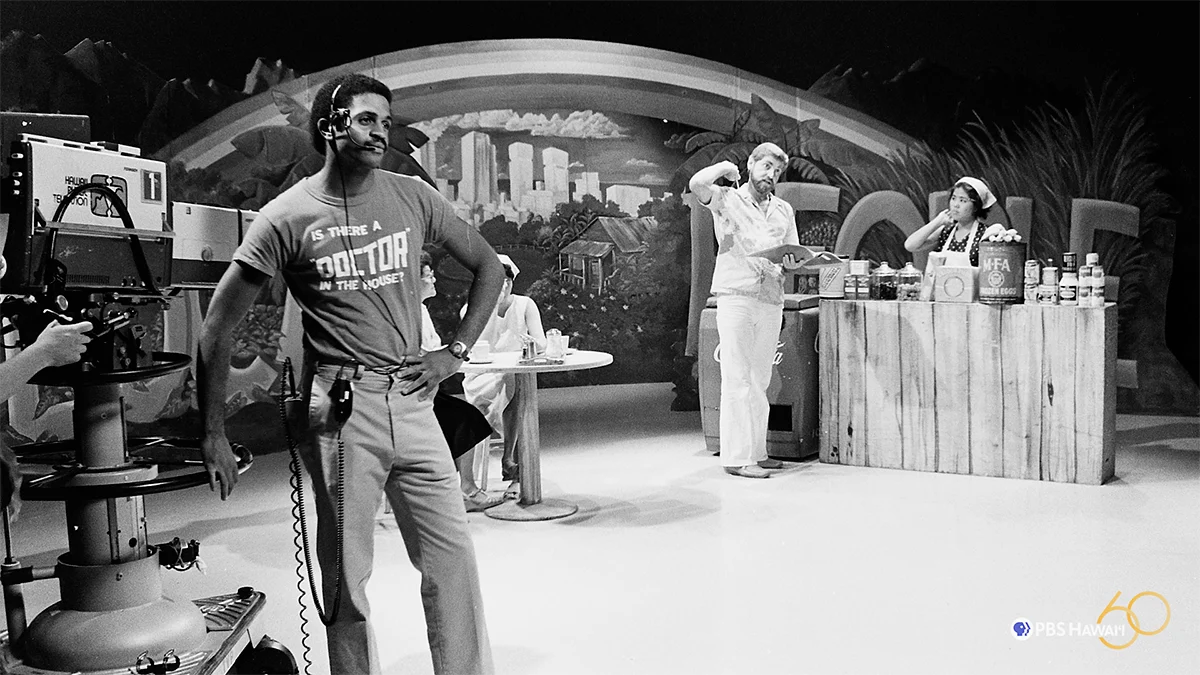
Student-employee Michael Harris on the set of International Kitchen, 1982. Photo: Courtesy of PBS Hawai’i
“There was a camera on a platform. Guys would go up these stairs and into the control room. And I was like, this is cool. I got to work in TV and it stuck with me ever since. Over 40 years later.”
Joy Chong-Stannard is a long-time director, producer and filmmaker who started in 1976. “I was a technical student, and when I started directing, we worked on a program called dialoguewhich is the precursor of Information about PBS Hawaiiand it was a live show, one of the only live shows where people could call in and send their questions to the panel. And what is important Insights is that it provides an hourly perspective that is not provided anywhere else in Hawaii.”
Bitterman adds, “I think what’s really important about the continued appeal of PBS Hawai’i is that we have so many stories to share, and we’ll never run out.”
Generous community support enables PBS Hawai’i to continue its mission. You can show your support during the next pledge drive on April 30 at 7:30 p.m.
PBS Hawai’i: 60 Years of Storytelling
Thursday, April 30, 7:30 p.m
Broadcasting and streaming pbshawaii.org i YouTube
SEE ALSO: Home is here: finding inspiration all around us
 Every month, HONOLULU publishes a blog written by the people of PBS Hawaiithe only locally owned state television station in Hawai’i that is supported primarily through donations. visit pbshawaii.org for more information on outstanding locally produced shows and the leading provider of educational and national programming. Explore music and the arts, discover in-depth documentaries, and learn what makes Hawai’i so special. Follow PBS Hawai’i on all platforms: @pbshawaii
